19 positional situations
From neutral starts to guard, passing, control and escapes. A broad map of the fundamentals.
BUILT ON THE MAT.
Nineteen fundamental situations. One place to document your solutions, identify weaknesses, and track how your jiu-jitsu evolves.
A roadmap for the work. A record of the progress.
19 Fundamental situations
08 Whole-map snapshots
112 Dated progress records
A FRAMEWORK.01 / CONNECT THE PIECES
A new escape. A different pass.
Another round that raises more questions.
Class gives you the pieces. Rolling shows you where they hold up. Understanding how those pieces fit into your own game can take longer.
MATBORNE gives that work somewhere to live: the answers you use, the positions that trouble you, and the connections you’re beginning to see.
Your instructors teach you jiu-jitsu.
This is where you keep track of what you’re learning.
02 / THE MATBORNE SYSTEM
Practical observations. Personal answers.
No overall score. No shortcut to rank.
From neutral starts to guard, passing, control and escapes. A broad map of the fundamentals.
Keep names and references for the techniques you learn in training. Make room for answers that change.
Notice how a named outcome works with smaller, middle and larger partners. Keep the conditions with the score.
Track how a position feels separately from whether you escape. Feeling composed is not a guarantee of safety.
Name the attack. Observe the setup and the attempt separately. A finish is not required to record development.
Return to the same assessment framework at any experience level. Eight dated packets, on your own schedule.
Preserve earlier solutions in dated records. Changing your main answer shouldn’t erase how you got there.
Record where you go next, where the route stalls, and the question you want to take to your coach.
03 / OPEN THE JOURNAL
Selected pages from the current interior.
Choose a page for a closer look.
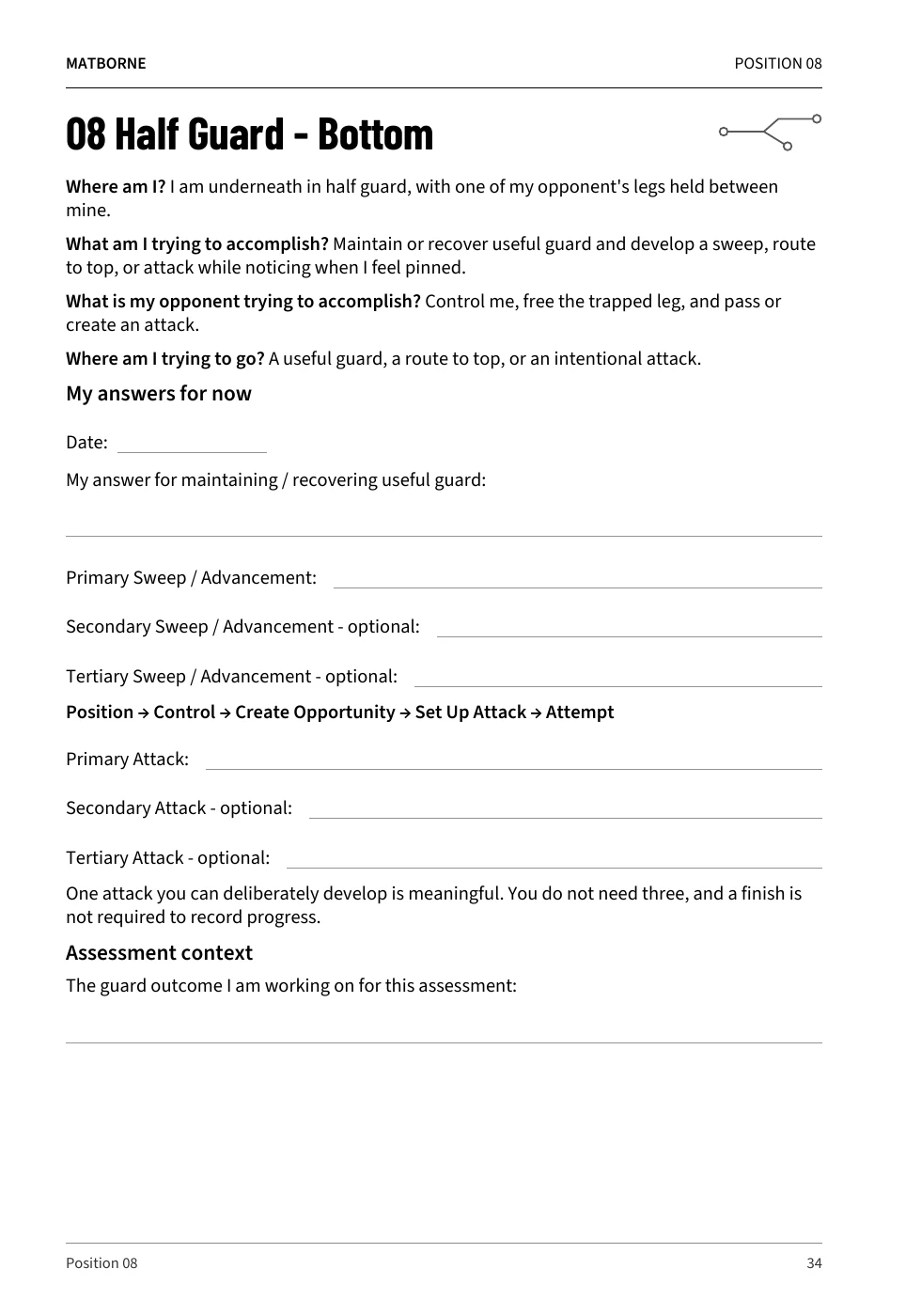
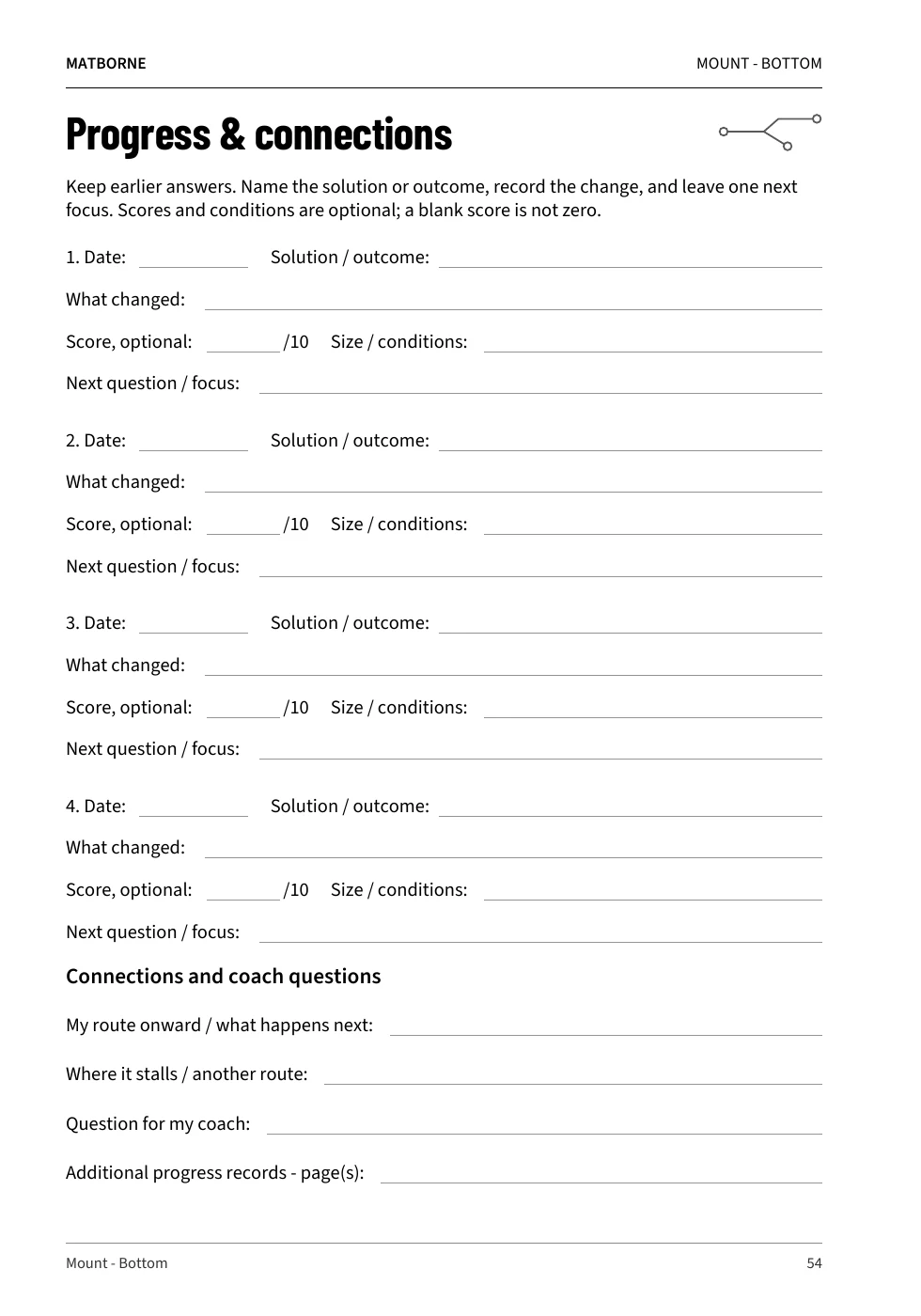
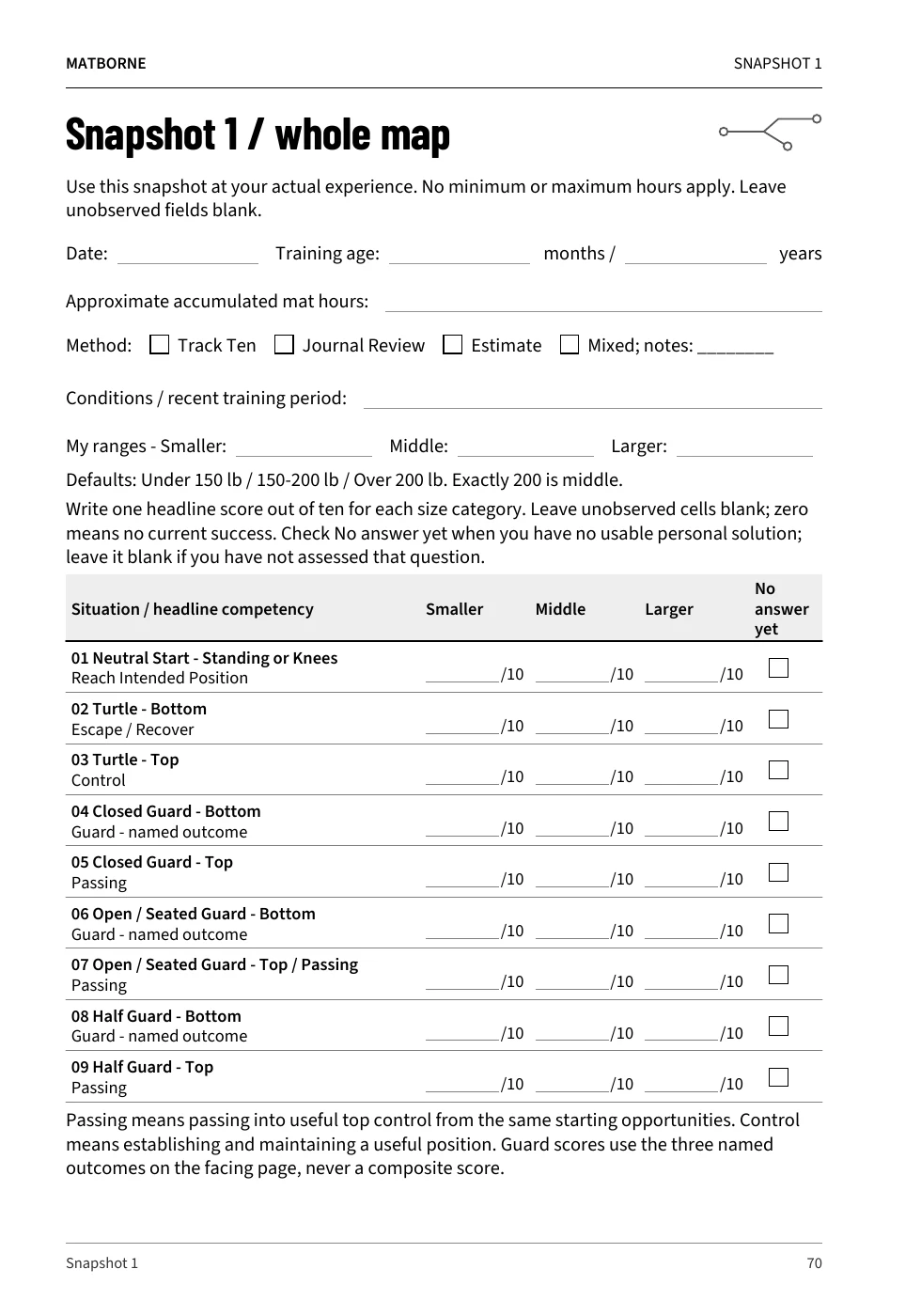
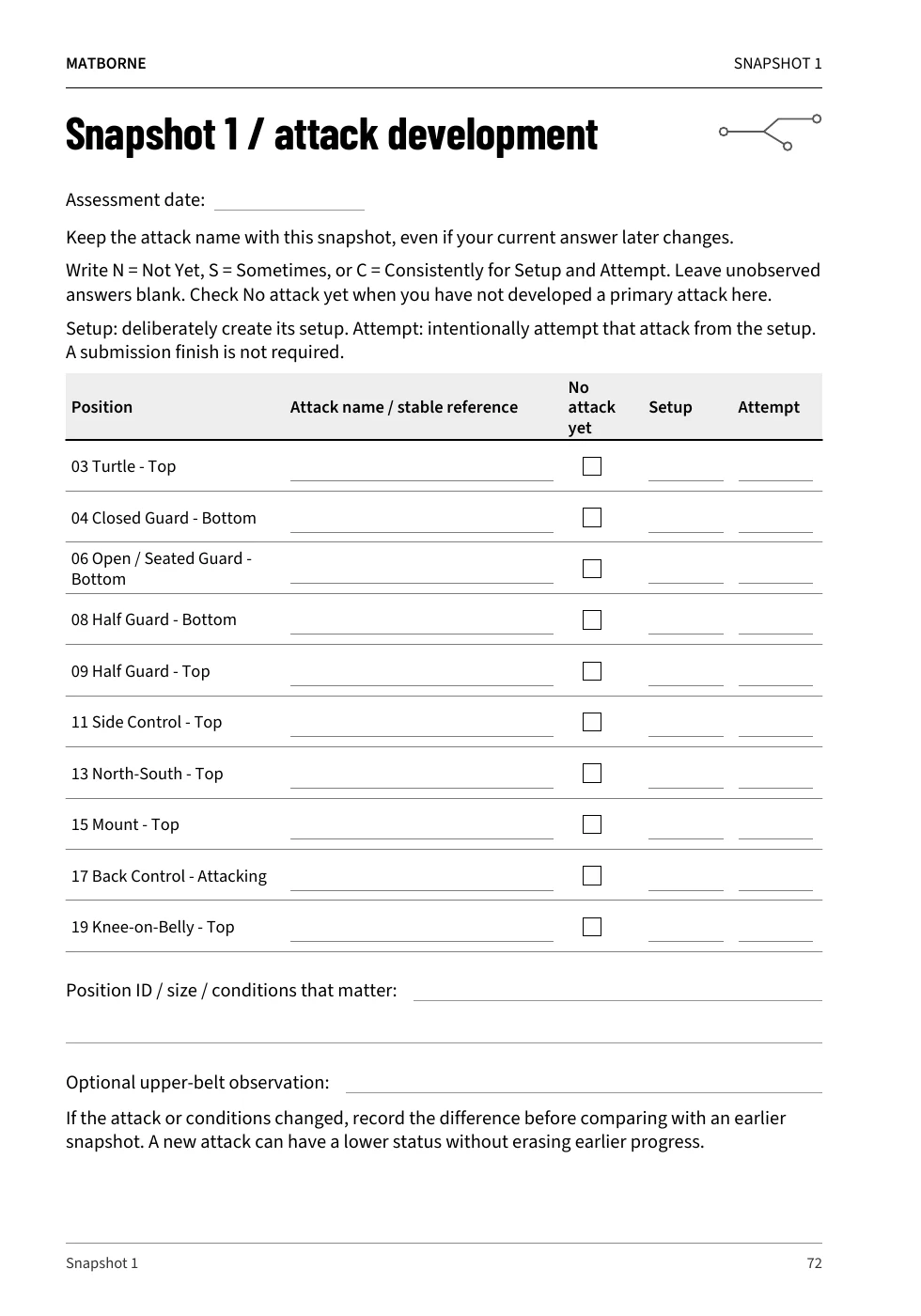
These are selected interior previews, not the complete workbook. Final cover and publication details are pending.
04 / BUILT FOR THE LONG GAME
Use it when something matters.
You don’t need to document every class.
Pick one position. Add a short observation, a solution name, or a question. A three-minute update can be enough.
Revisit a position. Name what changed and under which conditions. Take the next unused snapshot when it’s useful.
Earlier records show what your answers used to be. Keep them as context as your game—and your next training record—develops.
05 / FOR THE PEOPLE DOING THE WORK
For beginners, developing white belts, and newer blue belts auditing their fundamentals. Bring a question to your instructor; use the journal as an optional starting point for that conversation.
MATBORNE complements training and coaching. It does not replace instruction, teach advanced techniques, or determine promotion.
Cover concept · Final artwork to be selected
COMING SOON
Brazilian Jiu-Jitsu Fundamentals
Roadmap & Progress Journal
A compact physical companion to the work you’re already doing. Structured enough to see the map. Open enough to make it yours.
Current edition specifications. Release date and final cover to be confirmed.